Quick Answer:
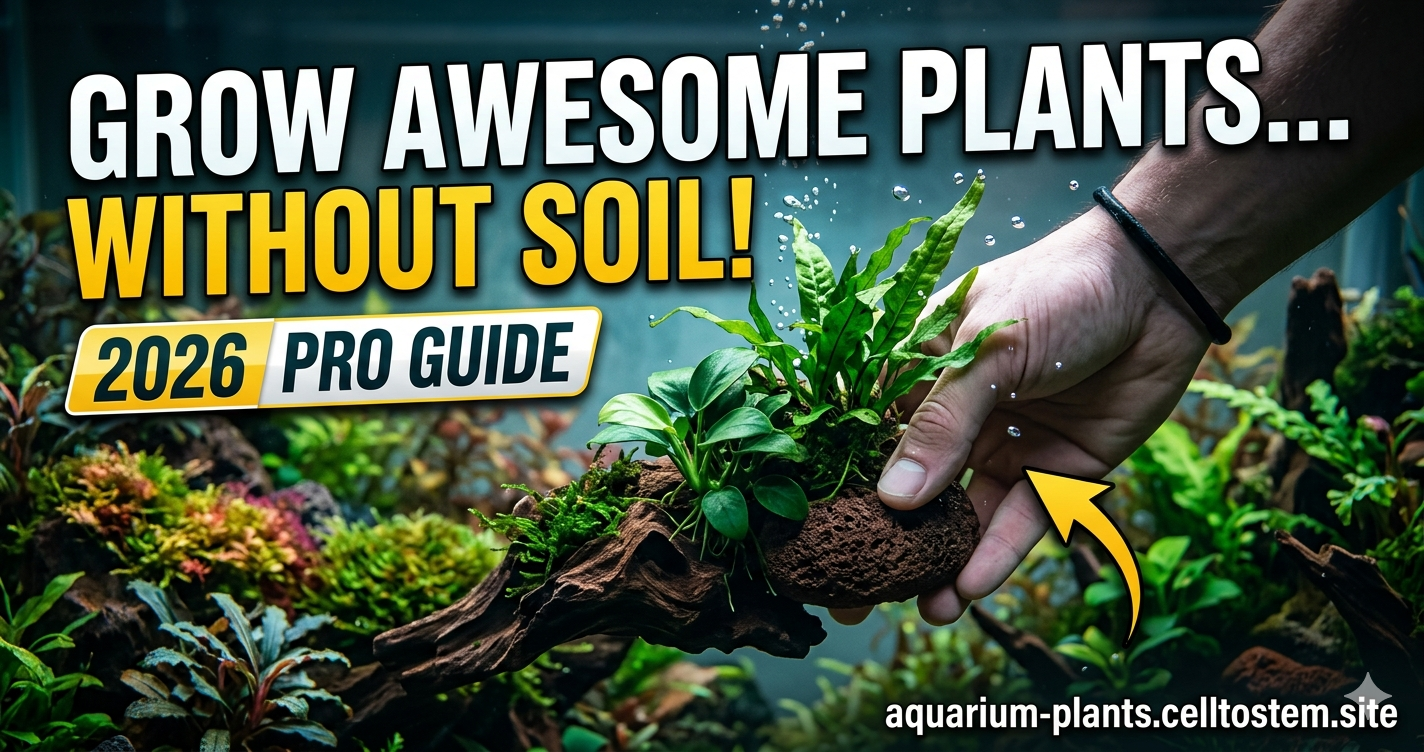
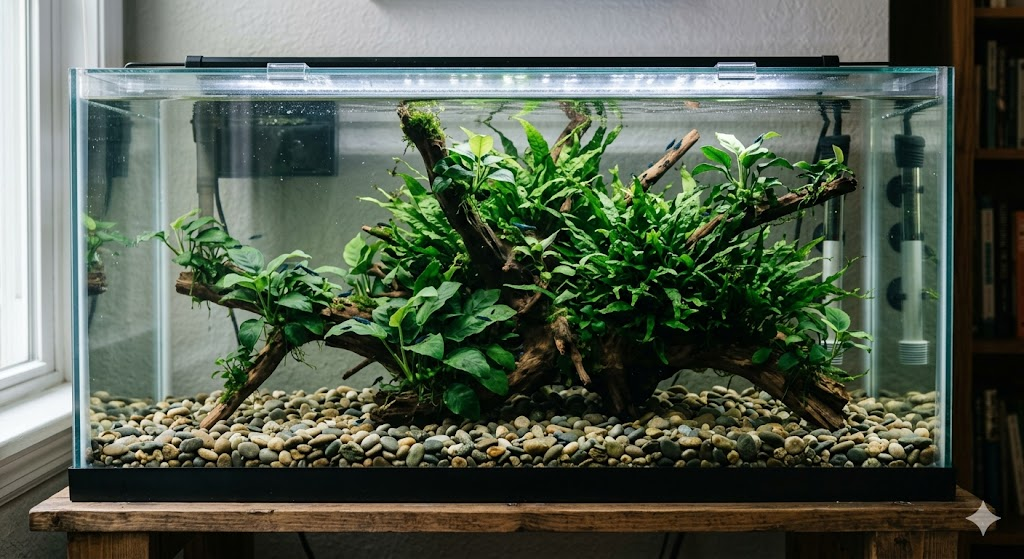
Yes, You Can Grow a Lush Tank Without Soil! You absolutely do not need soil or specialized “active” substrates to grow a beautiful planted tank. Instead, focus on epiphytes (plants that attach to wood or rocks), floating plants, and water column feeders. These plants, such as Anubias, Java Fern, and Amazon Frogbit, draw all their nutrients directly from the water rather than through a root system buried in dirt (Aquatic Arts, 2026; Ratemyfishtank, 2026).
My Journey from Muddy Disasters to “Floating” Success
I still remember my first “high-tech” planted tank back in 2018. I spent $100 on fancy aquarium soil, spent hours meticulously planting tiny stems, and within a week, my water looked like a chocolate milkshake. Every time a curious Corydoras catfish wiggled, a plume of dirt exploded into the water. It was a maintenance nightmare.
The turning point came when I discovered rhizome plants. I tied a single Java Fern to a piece of gnarly driftwood with some old fishing line. No soil. No mess. Not only did it survive my beginner mistakes, but it thrived. Since then, I’ve transitioned almost all my personal displays—especially my shrimp tanks and betta tanks—to no-soil setups. It is cleaner, easier to re-aquascape, and honestly, the plants look more “wild” when they are clinging to rocks and wood just like they do in nature (Aquascaperoom, 2023).
Why Ditch the Dirt?
The biggest misconception in this hobby is that “roots = soil.” In reality, many of our favorite aquatic species are water column feeder plants. Their roots are designed to grip surfaces or dangle in the current to pull minerals directly from the water.
Benefits of a no-soil aquarium:
- Zero Mess: No cloudy water when you move plants.
- Infinite Flexibility: You can literally pick up your “garden” (the wood or rock) and move it during a water change.
- Better Flow: Soil can develop “dead zones” where toxic gas builds up; bare-bottom or sand-only tanks stay much fresher (Ratemyfishtank, 2026).
The “Big Three”: Best Aquarium Plants That Don’t Need Soil for Beginners
If you are just starting, don’t overcomplicate it. These three categories are the “indestructibles” of the no-substrate world.
1. Anubias: The King of Epiphytes
Anubias is the ultimate low maintenance aquarium plant with no soil. Its thick, waxy leaves are almost plastic-like, meaning most herbivorous fish (even Cichlids!) won’t eat them.
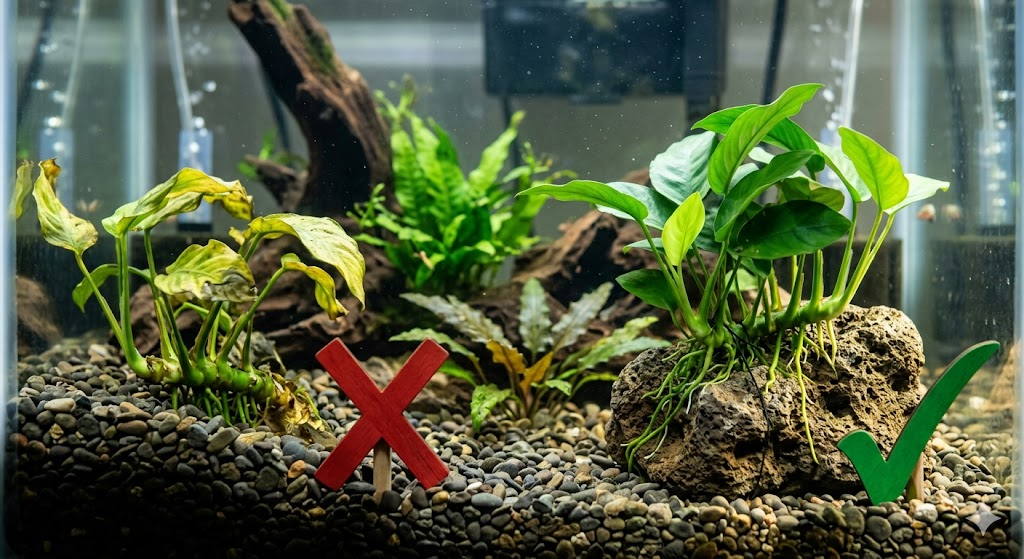
- The Golden Rule: Never bury the thick horizontal stem, called the rhizome, in the sand or gravel. If you bury it, it will rot and the plant will die (Buceplant, 2025; Aquascaperoom, 2023).
- Pro Tip: Use Anubias Nana Petite for small aquariums. It stays tiny and provides the perfect scale for a 5-gallon nano tank.
2. Java Fern (Microsorum pteropus)
Java Fern is a classic rhizome plant. It features long, flowing green fronds.
- Personal Lesson: I once tried to “plant” Java Fern in gravel. Within two weeks, the leaves turned black. Once I pulled it out and glued it to a rock, it exploded with new growth.
- Observation: It reproduces by growing “babies” (plantlets) directly on the tips of its leaves. Once they have a few roots, you can just pluck them off and move them (Ratemyfishtank, 2026).
3. Java Moss: The Versatile Carpet
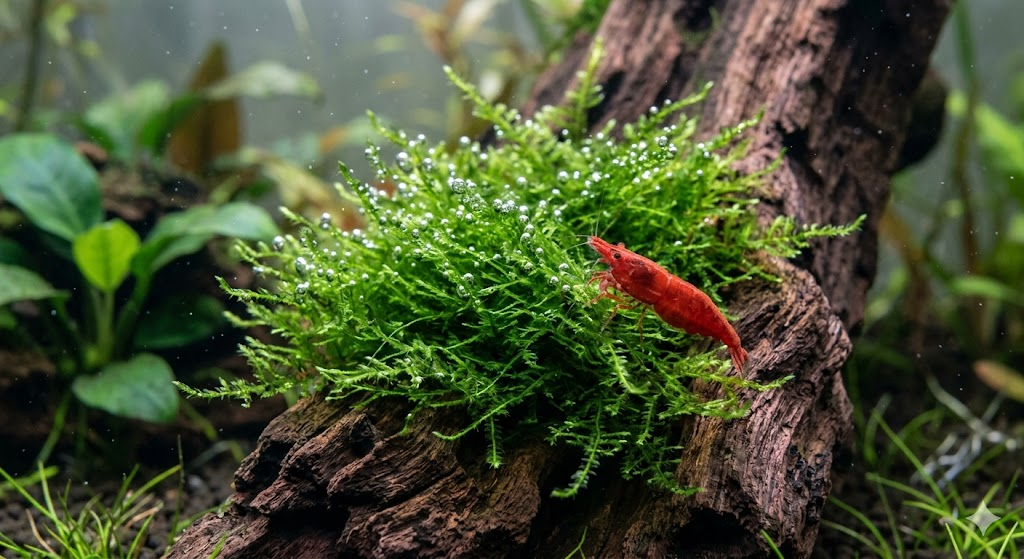
If you want a “grassy” look without a soil-based carpet, aquarium moss with no soil is your best friend. You can tie it to a mesh plastic grid or let it tangle around driftwood to create a lush, green cushion. It is essentially the best no soil plant for shrimp tanks because it traps “biofilm” that baby shrimp eat (Micro Aquatic Shop, 2023; Ratemyfishtank, 2026).
Best Aquarium Plants That Attach to Wood (No Soil)
Designing a “vertical” garden is where the real fun begins. Since you aren’t limited to the floor of the tank, you can use aquarium plants that grow on driftwood to fill the middle and upper levels of your water.
| Plant Name | Best For | Light Level | Growth Speed |
| Bucephalandra | Detail work / Colors | Low – Medium | Very Slow |
| Bolbitis (African Fern) | High-flow areas | Medium | Medium |
| Christmas Moss | Lush, bushy look | Low | Medium |
| Anubias Barteri | Background filler | Low | Slow |
My “Super Glue” Troubleshooting
Most people use fishing line to attach plants, but I’ve found that Cyanoacrylate-based super glue gel is a game changer (Aquascaperoom, 2023).
- The Trick: Apply a tiny dab to the plant’s roots (not the rhizome itself), press it to the wood for 30 seconds, and you’re done.
- The Fail: Don’t use too much glue! It turns white underwater. Use just enough to hold it until the plant’s natural “anchoring roots” take over, which usually takes about 4–6 weeks (Everyday Aquarist, 2014).
Best Floating Plants for Aquarium (No Soil)
If you want to keep your nitrates low and your water crystal clear, you need floating aquarium plants. These are the “filters” of the plant world.
The Best No Soil Aquarium Plants for Low Light
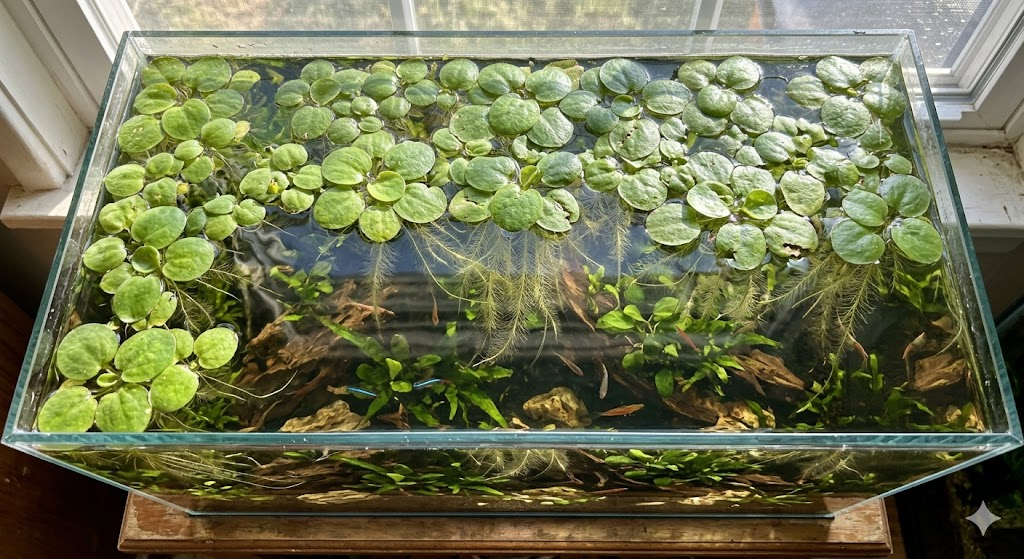
For tanks with standard “kit” LEDs, Amazon Frogbit and Salvinia Minima are unbeatable. They sit right under the light source, so they get plenty of energy even if your light is weak (Aquatic Arts, 2026).
- Best for Betta Tanks: Bettas love the long, dangling roots of Frogbit. It creates a “jungle” canopy that makes them feel secure (Aquatic Arts, 2026).
- The “Duckweed Warning”: While Duckweed is a great nutrient sponge, it is the “glitter” of the aquarium world. Once you have it, you can never fully get rid of it. If you want something easier to manage, go with Red Root Floaters (Aquatic Arts, 2026; Micro Aquatic Shop, 2023).
Specialized Setups: Shrimp, Bettas, and Low Light
Best Aquarium Plants No Soil for Shrimp Tank
Shrimp love surface area. Every leaf of an Anubias or strand of Java Moss acts as a pasture for the microscopic food they eat. For a shrimp-focused setup, I highly recommend Süsswassertang. It’s a weird, liverwort-like plant that looks like translucent green seaweed. It doesn’t have roots at all; it just sits in a clump and grows into a massive “shrimp mountain” (Aussie Fishkeeping, 2025).
Best Aquarium Plants Without Soil for Betta Tank
Bettas breathe air from the surface, so they need resting spots near the top. Anubias Barteri is perfect here—its broad leaves act like “hammocks.” I like to suction-cup a piece of wood with Anubias attached near the surface so my Betta can sleep on it.
Best No Soil Plants for Small Aquarium (Nano Tanks)
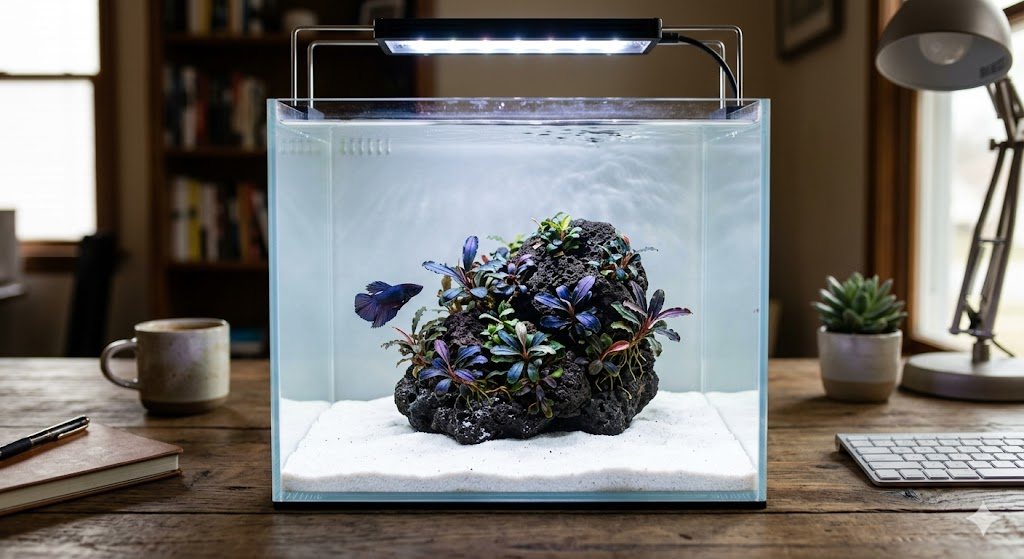
In a 5-gallon tank, space is at a premium. Soil takes up too much room. I prefer using Bucephalandra (or “Buce”). These plants are the “jewels” of the hobby. They often have a metallic blue or purple sheen and tiny white dots on the leaves that look like stars. They are tiny, stunning, and thrive on a small rock or pebble (Ratemyfishtank, 2026).
Professional Troubleshooting: Lessons from the Trenches
After a decade of keeping no substrate aquarium plants, I’ve noticed a few things the manuals don’t always tell you:
- The “Melt” is Real: When you first buy a Java Fern or Anubias, it might lose a few leaves. Don’t panic! Most of these plants are grown out of water (emersed) at the nursery. When you put them in your tank, they have to grow “underwater” (immersed) leaves. Give it two weeks before you give up on it (Buceplant, 2026).
- Algae on the Leaves: Because these plants grow slowly, they can become magnets for algae. If you see green spots, your light might be too bright. Floating plants are actually the solution here—they shade the slower-growing plants below (Aquascaperoom, 2023; Ratemyfishtank, 2026).
- Feeding is Key: Since there is no soil to provide food, you must use a liquid fertilizer. I’ve found that an “all-in-one” liquid dosed once a week is usually enough to keep them green and vibrant (Aquatic Arts, 2026).
Summary: Your Clean, Green, No-Soil Roadmap
You don’t need to be a scientist to have a stunning planted tank. By choosing epiphytes and floaters, you bypass the mess of soil and the complexity of root tabs.
Quick Recap of Your Options:
- To Attach: Anubias, Java Fern, Bucephalandra, Mosses.
- To Float: Amazon Frogbit, Red Root Floaters, Hornwort, Salvinia.
- To Weight Down: Hornwort, Anacharis, Guppy Grass (Aussie Fishkeeping, 2025).
If you want to dive deeper into specific species or find where to buy these locally, you can search Google for the best aquarium plant nurseries near you.
Frequently Asked Questions
Do plants without soil need fertilizer?
Yes. Because they aren’t pulling nutrients from the ground, they rely on the water. A high-quality liquid fertilizer provides the iron, potassium, and nitrogen they need (Aquatic Arts, 2026).
Can I use sand or gravel instead of soil?
Absolutely. Many no-soil plants can have their “anchoring roots” tucked into sand or gravel, as long as the rhizome (the thick stem) remains above the surface.
Why did my Java Fern turn black?
This usually happens if the rhizome is buried or if the plant is adjusting to new water parameters. It can also be a sign of “spore” production—small black dots on the underside of leaves are actually how the plant reproduces! (Ratemyfishtank, 2026).
How do I stop floating plants from taking over?
Use a “floating ring” (a piece of airline tubing joined in a circle) to corral them. This keeps a clear space for feeding and ensures light reaches the plants at the bottom (Aquatic Arts, 2026).